


Post
8 Min.
9. January 2026
Imperialist violence in the “backyard”: Background and implications of the US military intervention in Venezuela
Prof. Dr. Annika Oettler
Forscherin
Institut: Philipps-Universität Marburg
Alle Artikel dieser Autor:in
Prof. Dr. Stefan Peters
Forscher
Institut: Justus-Liebig-Universität Gießen, Instituto Colombo-Alemán para la Paz (CAPAZ) in Bogotá
Alle Artikel dieser Autor:in
Prof. Dr. Jonas Wolff
Forscher
Institut: PRIF - Leibniz-Institut für Friedens- und Konfliktforschung
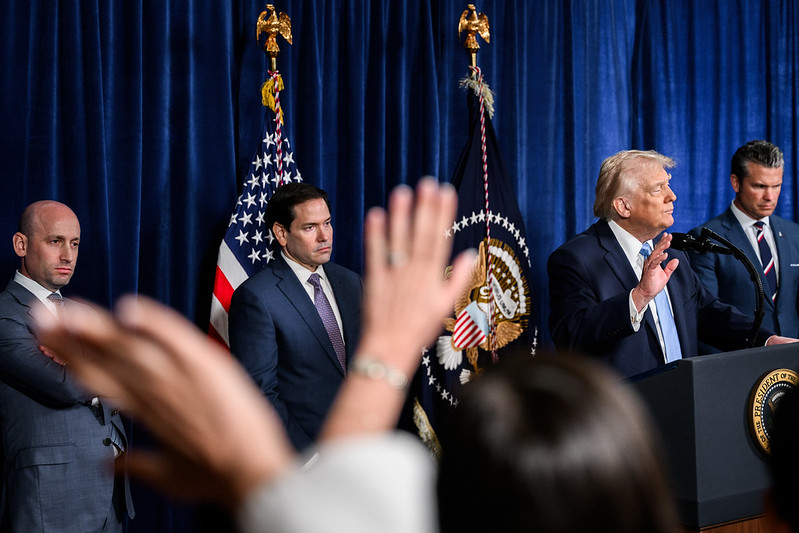
Alle Artikel dieser Autor:inThe military strikes against Venezuela on January 3, 2026, which culminated in the kidnapping of President Nicolás Maduro and his wife Cilia Flores, mark the culmination of the US’s confrontational policy toward the South American country (see below for background information on Venezuela). The attack on Venezuela was – and here there is agreement among legal experts such as Kai Ambos and Christoph Safferling – “illegal under international law” (see also beck aktuell and tagesschau). With this, the second Trump administration has taken its imperialist Latin American policy to a new level of intensity – both in terms of the means used and its public justification. The core of this policy is the threat and use of economic and military power. Consideration for restrictions under human rights and international law, democratic standards, or even basic principles of intergovernmental cooperation clearly play no role. Only domestic political calculations limit the US government’s scope for action. However, this is noticeable, as Trump’s MAGA movement stands for the promise of focusing on the narrowly defined interests of “the US” while renouncing costly foreign policy adventures (for criticism of the intervention from Republican circles, see Time, Politico, and The Hill).
As we highlight in this article, all of this is evident in the US military intervention in Venezuela and in the Trump administration’s broader Latin American policy. Equally apparent are the difficulties faced by the countries affected—initially in Latin America, but indirectly also in Europe—in finding a plausible, even unified response to blatantly imperialist US policy.
Venezuela
Venezuela is a classic oil-producing country and, in addition to the world’s largest oil reserves, is also home to other raw materials. Politically, the current government follows in the tradition of the Bolivarian Revolution proclaimed by former President Hugo Chávez (1999–2013), which was long considered the figurehead of the Latin American left. Under Chávez’s successor Nicolás Maduro, nearly 8 million people have left the country in the context of the most severe crisis in its history. Against this backdrop, it is only understandable that Maduro’s removal from office in Venezuelan exile is also causing enthusiasm. Politically, Venezuela is now an authoritarian regime with growing repression against political opponents and open election manipulation in the 2024 presidential elections. The Maduro government relied primarily on the military, police, and militias and received support from Cuba, Iran, Russia, and China. In addition, non-state violent actors from Colombia (ELN, dissidents of the demobilized FARC guerrilla group) operate in the country. Venezuela is a transit country for cocaine trafficking, from which state actors also profit. However, there is no evidence that the Venezuelan government is running drug cartels, and the US Department of Justice also doubts this.
Threats, sanctions, military force: US policy toward Latin America under Trump 2.0
The first target of military threats in the region was Panama, which quickly reduced its cooperation with China and intensified its cooperation with the US. Colombian President Gustavo Petro, who had briefly opposed the inhumane deportation of migrants by US military aircraft, also quickly backed down after Trump announced massive punitive tariffs. Brazil, for its part, was hit with US punitive tariffs to prevent the conviction of former President Jair Bolsonaro, who is close to Trump. In this case, however, the US government’s all-too-obvious attempt to use economic coercion to thwart a constitutional process elsewhere was unsuccessful. The beneficiaries of these political-ideological interventions are Trump’s right-wing allies. For example, the US government helped Argentine President Javier Milei through the difficult midterm elections with direct financial aid and threats of consequences if the population voted the wrong way. Nasry Asfura, the new president of Honduras, was also able to count on direct campaign assistance from the US – while Trump simultaneously pardoned Asfura’s former president and party colleague, Juan Orlando Hernández, who had been sentenced to 45 years in prison in the US for involvement in drug trafficking.
However, the military action taken by the US is even more dramatic in terms of its form and consequences. On the one hand, the establishment of a massive military presence in the Caribbean serves as a ruthless and brutal measure in the “war on drugs”: the military attack on suspected drug boats with the extrajudicial execution of all occupants. Added to this is the detention of Venezuelan oil tankers. And finally – after an initial drone attack at the end of 2025 – the aforementioned military intervention in Venezuela on January 3, 2026. As a result, however, there are currently no signs of regime change. Instead, the former vice president, Delcy Rodríguez, took over Maduro’s office, and the ruling power bloc remains intact for the time being. The new-old government of Venezuela is signaling its willingness to cooperate with the Trump administration, which is threatening further military strikes.
Imperialist ambitions and the alleged fight against “drug terrorism”: the justification for military force
In the thoroughly staged world of Trump’s politics, the theme of combating drugs became a central rhetorical device. This included both justifying the bombing of suspected drug boats belonging to the transnational organization Tren de Aragua and accusing Maduro of heading a Venezuelan cartel called Cartel de los Soles. This line of argument also featured prominently in President Trump’s 18-minute press statement on January 3, 2026, but has since been dropped by the US Department of Justice. With his familiar mix of hyperbolic phrases and catchy examples, Trump described the crime and drug problems in major US cities, the violence perpetrated by Tren de Aragua, and the successes of his crackdown. This brought the argument for bringing the “outlaw dictator, Nicolás Maduro” to justice to the forefront of the US government’s dramatic model. This argument, taken up by US Ambassador Waltz at the UN Security Council meeting on January 5, was also prominently featured in Chancellor Merz’s press release.
Beyond this argument, which is untenable under international law, Trump’s remarks contained even more far-reaching components. One of the most remarkable phrases in his press statement was this reference: “We are going to run the country until such time as we can do a safe, proper, and judicious transition.” This phrase does not “only” signal a clear form of occupation. The use of the verb “to run” is also revealing in that it bluntly shows that this is not about political governance, but about management in a more entrepreneurial sense. And this leads to the real core of the press statement: securing the transfer of resources to the US. As everyone knows, the oil business in Venezuela has long been a “total bust,” a complete failure, and now US oil companies would invest billions and restore the infrastructure. The implications of this imperial attitude remained extremely vague, however. Later in the press conference, Trump responded to the question of what “to run” meant exactly and who would have power in Venezuela: “Well, we’re gonna be running it with a group, and we’re gonna make sure it’s run properly. We’re gonna rebuild the oil infrastructure, which will cost billions of dollars.”
This is therefore a new level of justification for imperial policy, which corresponds to the addition to the Monroe Doctrine recently enshrined in the National Security Strategy as the “Trump Corollary.” It is about the supremacy of the US in the Western Hemisphere and securing resources, territories, and trade that are in the strategic interests of the US. The fact that this does not necessarily imply a democratic regime change is demonstrated by the rapid acceptance of transitional president Rodríguez. This means that institutional continuity, which leaves the Venezuelan military and the ruling elite untouched, as well as the shadow structures of illegal armed groups, is currently the most likely scenario for the near future.
US military interventions in Latin America
The early phase of US imperialist policy toward Latin America began immediately after the consolidation of the US state, which expanded its territory through “checkbook diplomacy” and military conquest (including Louisiana, Florida, and Texas). The heyday of US interventionist policy (1940s to 1980s) was marked by the Cold War and the containment policy, a policy of containing communism that also involved the use of force. This phase saw a whole series of covert and overt US interventions. In the current context, the most discussed intervention is the military invasion to remove Manuel Noriega from power in Panama (1989/90). Noriega’s violent overthrow was preceded by a prolonged escalation. On December 20, 1989, US President George Bush justified the attack in a short television address, saying it was to protect threatened US citizens and bring Noriega to justice for drug trafficking. Both the Organization of American States (OAS) and the UN General Assembly condemned the military intervention. The violent removal and subsequent conviction of Noriega had no effect on international drug trafficking.
Implications for Latin America
The military intervention in Venezuela has implications for the entire region (see below for information on previous US military interventions in Latin America). First, it highlights the political divisions within Latin America. The reactions of the region’s governments followed the expected political divisions. While the right-wing parties supported by Trump welcomed the military strikes, Brazil, Chile, Colombia, Mexico, Uruguay, Cuba, and Nicaragua condemned the US action. The reactions show that there is currently no common position in the region on respect for international law. The Trump administration’s signals that it is willing to come to terms with the Chavista transitional government and ignore the opposition leader, María Corina Machado, in the power struggle will also unsettle right-wing hardliners in the region. In addition, the intervention is polarizing domestic political debates in the countries of the region and will also influence this year’s parliamentary and presidential elections in neighboring Colombia.
Secondly, the intervention in the region makes it clear that the US government has no qualms about using military force to assert its interests. The Trump administration is concerned with economic interests, geopolitical dominance, and intensifying the militarized war on drugs, while democracy, human rights, good governance, sustainable development, and even social justice play no role. Thirdly, it is clear that Latin America has become a battleground for geopolitical and geo-economic interests between the US and China, and to a lesser extent Russia. In the past, China has granted Venezuela large loans in exchange for future oil supplies. Russia also has economic and political-military interests in Venezuela. These interests and claims are now being contested by the US. In line with the Monroe Doctrine (1823), the realignment of US strategy also involves demarcating its own influence vis-à-vis Europe. The National Security Strategy explicitly refers to “non-Hemispheric competitors.” Accordingly, the scope for “active non-alignment” as a possible foreign policy strategy for Latin American states in the context of global political conflicts is also narrowing.
Fourthly, disregard for the principles of international law raises fears of destabilization in the region. Intensification of the military fight against “drug terrorism” by the US and its allies means an escalation of violence, with the civilian population in particular caught between the fronts. Added to this is the obvious risk of further US attacks—in case of doubt, also of a military nature—on other states, as suggested by Trump’s threats against Colombia, Cuba, Mexico, and Denmark/Greenland.
Conclusions and outlook
Regardless of all the insecurity about the specific intentions and plans of Trump he pursues his Latin America policy more or less consistently along four goals. First it is about strengthening ideologically similar forces as partners or lackeys and break open resistance against US-claims with potentially all means. This is secondly connected, in the spirit of the classic Monroe-doctrine, with the goal to reduce the influence of extra-regional powers mainly that of China. Thirdly, domestic interests defined with a high priority should be catered to specifically migration, the supply of resources for the US, the profits of US-companies as well as the war on drugs. Fourth, it is about the preferably spectacular showcasing of unlimited, imperial power- of the US in general and of the president in particular. Therefore all means are deemed legitimate to reach these goals. The consideration of international norms or partners does not play a role. A limiting factor, however, is the domestic policy: according to the slogan “America First” the international engagement is not allowed to be too costly and has to literally be worth it. The domestic skepticism towards US-military interventions especially in the MAGA-camp is therefore the Achilles heel of Trump’s policy.
Accordingly, there are two options for Latin America and Europe: submit to the imperial ruler and hope that he reacts with grace or pick a strategy of targeted resistance that does generally take a confrontational stance against the US but clearly and unmistakably position itself against threats that go against international law and military actions. Such a response should have the goal of increasing the domestic costs for Trumps aggression, for example on the economy. This calls for an intensification of alternative political and societal coalitions such as between Europe and Latin America as well as with civil society, cultural and economic actors in the US. However, this requires will and ability to collective action that is lacking at the moment on both sides of the Atlantic.
Note: This post is from the PRIF Blog of the Peace Research Institute Frankfurt (PRIF) and was published on January 9, 2026. It is based on TraCe Policy Brief No. 12 (PDF, accessible). The Research Center “Transformations of Political Violence” (TraCe) is an interdisciplinary research network of five Hessian research institutions: the PRIF – Leibniz Institute for Peace and Conflict Research, Goethe University Frankfurt, Justus Liebig University Giessen, Philipps University Marburg, and the Technical University of Darmstadt.
Über diesen Artikel
Lesen Sie auch

The status quo in transition: East Jerusalem during Ramadan 2026
The German version can be found here, During Ramadan, East Jerusalem regularly makes headlines. These reports focus less on the city’s colorful Ramadan traditions or the general religious significance of the Temple Mount (Arabic: Haram al-Sharif, the Noble Sanctuary / Hebrew: Har ha-Bayit, Mount of the House or Temple), which is considered a particularly holy […]
Greek strawberries “made in Bangladesh”
Strawberries are now also available to buy in winter. They thrive in Nea Manolada, Greece, but there are downsides to growing them. Scientist Johannes Jungfleisch has investigated the conditions of South Asian workers.
On the Run – The Story of Mouhamed
The German version is here. On a typical weekday, life in the city is bustling. Many different people are busy going about their daily routines. Some would like to find work, but they can’t—they are forced to wait. Mouhamed is one of them. He was born in Cameroon in 1994 and studied political science. After […]