


Post
9 Min.
18. December 2025
In the engine room of East Germany’s transformation

Prof. Dr. Dierk Hoffmann
Stellvertretender Leiter der Berliner Abteilung
Institut: Institut für Zeitgeschichte (IfZ)
E-Mail: hoffmann@ifz-muenchen.de
Alle Artikel dieser Autor:inThe Treuhandanstalt was an agency under the Federal Ministry of Finance responsible for the privatization of the East German economy, and its activities in reunified Germany remain highly controversial to this day. In East Germany in particular, the Treuhandanstalt has left a deep imprint on the collective memory. There is no doubt that the agency’s track record is devastating: Of the approximately 12,000 Treuhand enterprises (the former state-owned enterprises), 30 percent were liquidated; of the original four million jobs, only a third remained in the end. Yet to view this as a failure of the agency would be inappropriate and one-sided.
I. On the Establishment of the Treuhandanstalt
The establishment of the Treuhandanstalt can be traced back to East German civil rights activists during the peaceful revolution of 1989, who sought to prevent the sell-off of GDR enterprises to SED cliques as well as to Western investors. West and East Germany quickly agreed that Western—and thus primarily West German—capital was necessary to meet the challenges facing the GDR economy. This explains the efforts of the GDR government under Prime Minister Hans Modrow (SED/PDS) to attract investors from the West. To this end, a Joint Venture Act was passed in January 1990 by the People’s Chamber (the GDR’s undemocratically constituted parliament), which allowed foreign capital participation in East German companies of up to 49 percent.
The desire for foreign investors opened the door to the privatization of East German enterprises. Against this backdrop, a shift in function took place, reflected in the Law on the Privatization and Reorganization of State-Owned Assets (the Treuhand Act for short), which the freely elected People’s Chamber passed on June 17, 1990, and which formed the central legal basis for the agency’s work until its official dissolution at the end of 1994. Its most important task was no longer the preservation of “state-owned assets,” but rather their privatization. It was believed that the proceeds generated in this way would make it possible to finance the structural transformation of the East German economy. Seen in this light, the Treuhandanstalt suddenly became a tool for solving a massive economic problem.
II. The Treuhandanstalt under Detlev K. Rohwedder
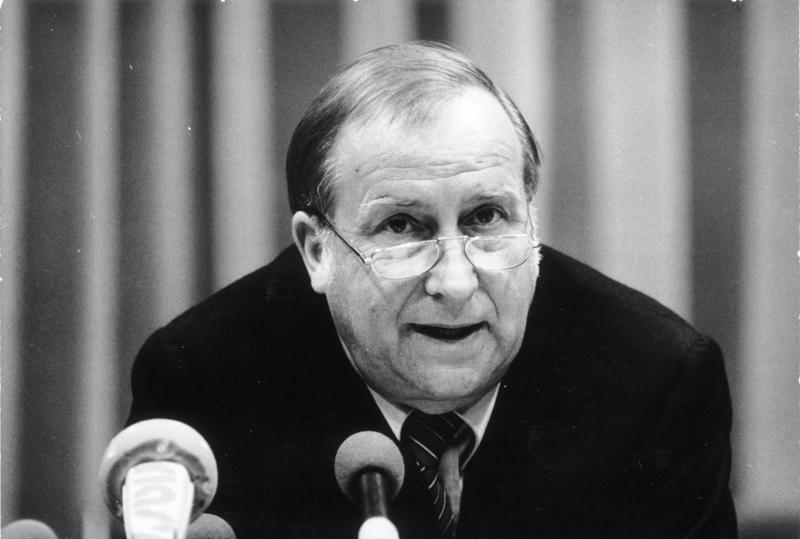
By the summer of 1990, the first major privatization decisions (e.g., involving banks, insurance companies, newspapers, and publishing houses) had been made without the Treuhandanstalt’s involvement. Since its founding on March 1, 1990, it had been nothing more than a toothless paper tiger. It was only during Detlev Karsten Rohwedder’s brief tenure as president of the Treuhand that, starting in late August 1990, it evolved into a functional agency capable of fulfilling its statutory mandate. Within a few months, the workforce grew rapidly: from 379 (as of September 30) to 1,140 (as of December 31, 1990). Rohwedder initiated not only the massive expansion of personnel but also the structural reorganization of the Treuhandanstalt to make work processes more efficient.
While the majority of the Treuhandanstalt’s workforce was from East Germany, this was not the case for leadership positions on the executive board and in the individual directorates. Leadership positions were quickly taken over by West Germans. One reason for this was actual or perceived conflicts of interest stemming from the membership of government employees in the SED or the Ministry for State Security (so-called “old boy networks”), which were a central topic of public debate in East Germany at the time.
In late summer 1990, the Treuhand leadership realized that the privatization course they had embarked upon would lead to plant closures and mass unemployment. Consequently, they sought a response to the economic downturn in East Germany. In late September, the executive board discussed labor market and social policy measures. The discussion centered on the development and financing of social plans as well as the implementation of job creation measures (ABM). Among the additional tasks assigned to the agency by policymakers were the modernization of industrial facilities, a targeted policy for small and medium-sized enterprises, and the handling of contaminated sites on the premises of Treuhand companies.
The expansion of the Treuhandanstalt’s scope of responsibilities raised questions of state and constitutional law. This was because the agency encroached upon the finely balanced interplay between the federal government and the states. Moreover, the Treuhandanstalt was a foreign element in the federal order of the Federal Republic, which threatened to be thrown off balance. This was because the Berlin-based agency, through the industrial and structural policies assigned to it, was directly intervening in the domain of the states, a move viewed with suspicion by the West German states. Consequently, many political actors—including state governments and business associations, as well as the federal governments in both West and East—had a strong interest in the agency’s prompt dissolution.The Treuhandanstalt was not intended to be a permanent institution.
III. The Treuhandanstalt under Birgit Breuel
In the spring of 1991, an event shook the German public: On the night before Easter Monday, Treuhand chief Rohwedder was the victim of an assassination attempt attributed to a cell of the Red Army Faction (RAF). Although criticism of the agency did not subside, the mass protests in East Germany subsided somewhat. As early as April 13, the Board of Directors appointed Birgit Breuel as the new president of the Treuhandanstalt, who emphasized continuity with her predecessor from the very beginning.
Staff expansion continued: by mid-1991, the Treuhandanstalt had a total of 2,722 employees, and six months later, 3,604. The agency reached its peak on June 30, 1992, when the workforce stood at 3,941. This was followed by the agency’s downsizing, which was also reflected in declining employee numbers—first in the regional offices and subsequently at the Berlin headquarters. On December 30, 1994, the head of the Treuhandanstalt removed the agency’s sign from the entrance area of her office in front of rolling cameras. This symbolic act marked the dissolution of the Treuhandanstalt. Its responsibilities were taken over by the Federal Agency for Special Tasks Related to Unification (BvS), which still exists today. The latter is currently still in the process of liquidation. While the Treuhandanstalt remains widely recognized in eastern Germany to this day, hardly anyone in the general public is familiar with the BvS.

Although there was documented evidence of white-collar crime in connection with the privatization of East German enterprises—some of which had already been uncovered in the early 1990s and which permanently damaged the Treuhandanstalt’s reputation—the agency’s history cannot be reduced to this alone. For instance, a special task force was established within the agency to investigate criminal matters at the Treuhandanstalt, led by a suspended public prosecutor. It had two objectives: First, it signaled to the public that the agency’s leadership was responding to abuses and misconduct. Second, it served as a disciplinary measure for the Treuhandanstalt’s employees. Incidentally, the exact number of corruption cases cannot be determined with certainty.
Under Birgit Breuel, the Treuhandanstalt’s privatization deals accelerated. While the number of individual decisions in the first quarter of 1991 was still around 800, it rose to about 1,500 within six months (third quarter of 1991). Neither the federal government nor the Treuhandanstalt had a coherent plan for the privatization of East German enterprises. Privatization proceeded very differently on a case-by-case basis and depended on several factors. When conducting a historical assessment, factors such as the size of the business, the timing of privatization, market conditions and profitability, the product range, potential buyers, and the local political environment must be taken into account.
In addition, the development of the companies up through the 2000s must be considered, as the initial privatization did not yet guarantee a business’s survival. In general, the decisions made by the Treuhandanstalt in the initial phase suffered from a lack of time and technical expertise. In short: there was too little staff, and the staff was not sufficiently qualified, for this mammoth task. Added to this is the fact that there was no prior experience to draw upon for corporate privatizations of this scale.
“There were too few staff members, and those who were available lacked the necessary qualifications, to tackle this mammoth task. Compounding the problem was the fact that there was no prior experience to draw upon for corporate privatizations on this scale.”
– Prof. Dr. Dierk Hoffmann
The real Herculean task facing the Treuhandanstalt was the economic restructuring of East Germany. For the SED leadership, guaranteeing full employment (the so-called “right to work”) was non-negotiable. Consequently, the SED had done little to adapt the GDR economy to developments in the global economy. From the perspective of the rulers in East Berlin, this did not seem necessary either. For with the reorganization of production relations, the implementation of a planned economy, and the integration of the GDR into the Soviet Union’s socialist economic system, they believed they had found an answer to the crisis of capitalism during the Great Depression of the late 1920s, which had contributed to the rise of fascism and National Socialism.
Yet this delayed structural transformation proved to be a major burden for East German enterprises, as became clear after the fall of the Berlin Wall in 1989. For now the price had to be paid for the SED leadership’s steadfast refusal in the 1970s and 1980s to respond to the pressure for change stemming from global structural transformation. The economic transformation in East Germany that began in 1989–90 took place in just a few years. By comparison, structural change in West German coal mining in the Ruhr region, for example, spanned six decades—from the late 1950s to 2018.
IV. Experiences of Loss and Protests
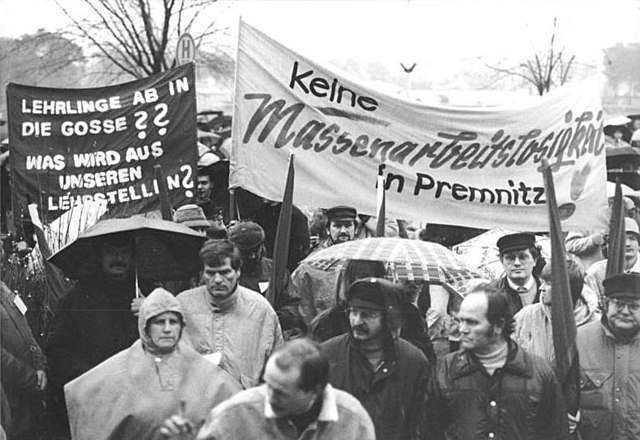
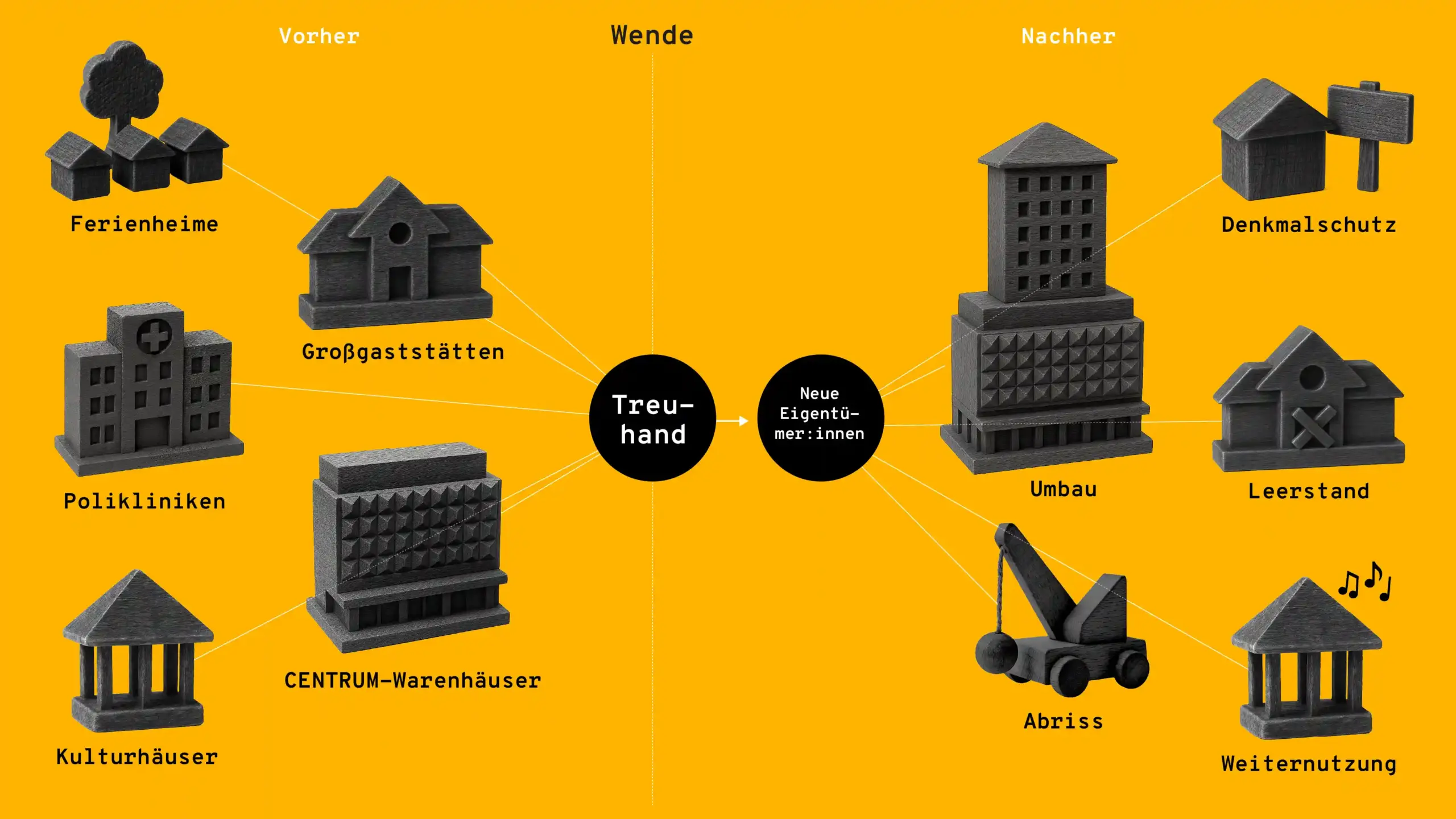
The experience of mass unemployment, which many East Germans faced for the first time after 1990, not only created new social inequalities but also had a lasting impact on the political and cultural attitudes of many people in the eastern German states. The plant closures did not merely result in the loss of jobs once believed to be secure. They also brought an end to the enterprise-centered socialist working world, which, until the fall of the Berlin Wall in 1989, had provided the population with a comprehensive range of services—from polyclinics, daycare centers, and vacation homes to after-work centers and cultural centers. This transformed working environments and the traditional family and gender roles associated with them.
Furthermore, it became apparent as early as the beginning of the 1990s that the socialist working world guaranteed by the SED regime had shaped the expectations of large segments of the East German population in the long term. By all accounts, many East Germans favored a strong, i.e., caring state that did not leave the shaping of social reality to the market.
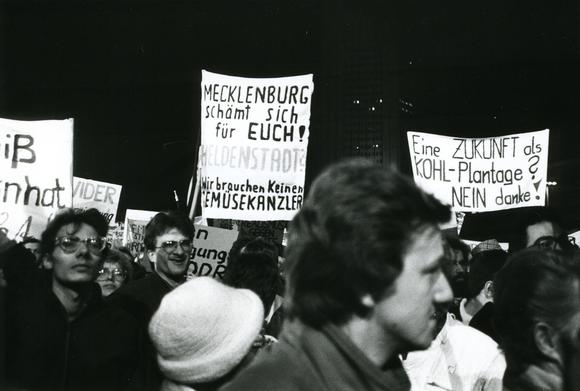
The protests that began in eastern Germany in late 1990 against the Treuhandanstalt’s privatization policies continued to intensify in the spring of 1991. Outside the gates of many factories whose future was uncertain, workers demonstrated to save their jobs. The protests, supported by unions and works councils, were decentralized and organized at the local level. The dispute over the closure of the potash mine in Bischofferode and the ultimately unsuccessful hunger strike by the potash miners in 1993 are considered the peak and turning point of the wave of protests in East Germany.
All stakeholders—the Treuhandanstalt, the federal government, the Thuringian state government, and the unions—were completely taken by surprise by the scale of the public protests and the intense media interest. To this day, Bischofferode represents not only a highly charged site of memory for East German structural change but also illustrates the selective perception of socioeconomic processes in the media landscape. In contrast, the East German textile industry plants, which also had to close in the 1990s, received no comparable attention.
V. Myths and Legends
Die Tätigkeit der Treuhandanstalt wurde frühzeitig von Fehleinschätzungen und einer misslungenen Kommunikationspolitik begleitet. Das zeigte sich schon im Herbst 1990, als Präsident Rohwedder in der Öffentlichkeit etwas vorschnell eine Bilanzsumme des volkseigenen Vermögens nannte, die sich rasch als Fehleinschätzung entpuppte. Der Treuhandchef hatte gegenüber insistierenden Pressevertretern erklärt, die ostdeutschThe Treuhandanstalt’s activities were marred from the outset by misjudgments and a failed communication strategy. This became apparent as early as the fall of 1990, when President Rohwedder somewhat hastily announced in public a total balance sheet value for state-owned assets that quickly turned out to be a miscalculation. The head of the Treuhand Agency had told insistent members of the press that the East German economy was allegedly worth 600 billion Deutschmarks. This figure was based on initial estimates by the Modrow government. For this reason, the Bonn Ministry of Economics had long assumed that rapid privatization would yield high proceeds. However, this did not take into account the so-called legacy debts of GDR enterprises, which had played no role in the planned economy but amounted to approximately 120 billion Deutschmarks following the currency conversion on July 1, 1990.
In addition, the opening D-mark balance sheets were still pending: corporate balance sheets that the Treuhand companies still had to prepare for the transition to a market economy and that were to significantly cloud the picture of the condition of East German enterprises. The expected sales proceeds ultimately resulted in heavy losses. When the Treuhandanstalt closed its doors at the end of 1994, the accumulated privatization losses were officially reported at 260 billion DM. However, these figures represent only the lower end of the total cost; the cost of German reunification was much higher.
“The experience of mass unemployment, which many East Germans faced for the first time after 1990, not only created new social inequalities but also had a lasting impact on the political and cultural attitudes of many people in the eastern German states.”
– Prof. Dr. Dierk Hoffmann
To this day, the Treuhandanstalt is associated with dashed hopes, exaggerated expectations, and self-deception. This includes, for example, the promise of “flourishing landscapes” that Chancellor Helmut Kohl (CDU), as well as other West German politicians and business leaders, made to the East German population in the summer of 1990. Among the enduring myths that continue to have an impact today is also the claim made by Erich Honecker in 1967 that the GDR was among the ten largest industrialized nations in the world. Even before the end of SED rule in 1989, this claim bore no realistic relation to the development of the real economy in the GDR.
Two lessons can be drawn from this: First, it is essential to recognize the complexity of the economic challenge associated with the transition from a planned to a market economy. There were no models to follow. Second, it is important to take greater account of the different experiences of people in the East and West, which had developed over the course of more than 40 years of division and which continued to have a lasting impact long after the turning point of 1989/90.
Dierk Hoffmann is deputy director of the Berlin branch of the Institute of Contemporary History Munich–Berlin (IfZ) and adjunct professor of modern and contemporary history at the University of Potsdam. From 2017 to 2024, he led a major, multi-part project at the IfZ on the history of the Treuhandanstalt.
Über diesen Artikel
Lesen Sie auch

How the withdrawal of military troops continues to shape a place
It looks like an enchanted place today – the former base of the Soviet army on the Oder Island in Küstrin-Kietz. The village is located in Brandenburg, directly on the Oder and the Polish border. More than almost any other place, it has been shaped by the Cold War, decades of military presence and the […]
Morgenröthe-Rautenkranz: From a Propaganda Site to a Modern Space Museum
Click here for the German version. In the late 1970s, the small mountain village of Morgenröthe-Rautenkranz in the Vogtland region suddenly became a state-sponsored pilgrimage site. The reason for this was the so-called “space-first” achievement of the “Workers’ and Peasants’ State”: “The first German in space—a citizen of the GDR,” East German media proudly reported […]
Seeking a new narrative – How a small town is reinventing itself
The name Lauchhammer has little to do with the vegetable that adds flavour to stews and soups. Lauch means ‘moor’ in Lower Sorbian and refers to the landscape in southern Brandenburg where the small town is located. The word “hammer” in the town’s name alludes to its industrial tradition. Iron ore has been mined and […]