


Post
3 Min.

23. February 2026
Emerging Adulthood: Why Your Life Is Changing So Much Right Now—and Why That’s Normal
Prof. Dr. Raffael Kalisch
Research Group Leader, Leibniz Institute for Resilience Research (LIR), Mainz, Germany
Institut: Leibniz-Institut für Resilienzforschung
E-Mail: raffael.kalisch@lir-mainz.de
Alle Artikel dieser Autor:inClick here for the German version.
The transition to adulthood is a special time. Between the ages of about 18 and 25, a lot often changes: school or college ends, the first job begins, you might move out on your own, and relationships change or become more serious. Many young people find these years exciting—but also exhausting or uncertain.
Important to know: This phase is not a personal problem, but a completely normal stage of life. Researchers call it “emerging adulthood.” This time has always been marked by upheaval. People try new things, ask questions like “Who am I?” or “What do I want in life?” This can sometimes feel chaotic, but it’s a natural part of development.
Scientific studies show that such changes bring not only stress but also opportunities for personal growth. In a study with young adults in Australia, we examined how people cope with typical challenges—such as exam stress, relationship conflicts, or uncertainty about the future. Many participants reported that they learned something about themselves from these experiences: for example, how they cope with stress, who supports them, or what truly matters to them. These new insights can strengthen the ability to cope with difficult situations in the long term—in other words, make people more resilient.
This means that even if a problem feels overwhelming right now, it can lead to greater self-confidence and clarity later on. Researchers describe this process as a kind of learning loop. You face a challenge, reflect on it, try out new strategies—and in this way, step by step, build greater resilience. Ideally, you grow alongside your tasks and challenges and feel ready to take on new ones.
Of course, people deal with this phase differently. Some feel more confident quickly, others take longer. Some experience more stress, others less. That’s completely normal. The important thing is: there’s no single right path to adulthood
In a large-scale long-term study of young adults in Germany, the Mainz Resilience Project (MARP), we found that a certain mindset can be particularly helpful. Young people who tend to view difficult situations realistically but with a slightly positive slant remain more psychologically stable in the long term. They take problems seriously but at the same time believe they can handle them. We call this mindset a “positive evaluation style.”
What do our findings mean for young people?
If your life feels like it’s in a state of upheaval right now, you’re not alone. This phase is a natural part of growing up. It can be exhausting, but it also offers the chance to get to know yourself better. Every challenge can help you develop new skills—even if that isn’t always immediately apparent.
You don’t have to handle everything perfectly. It’s enough to learn step by step. Talking to friends, family, or counseling services can help. And sometimes, just knowing that many others are going through similar experiences—and growing from them—can be comforting.
The path to adulthood is rarely straight. But it’s a time when a lot can develop. Change doesn’t just mean uncertainty. It can also be the beginning of something new.
If you think professional help might be good for you:
At many universities, a psychological counseling center can be a good first point of contact; some employers offer employee assistance programs. Health insurance providers can often help arrange an initial consultation as well.
Or take a look here—it’s a free online resource from the Leibniz Institute for Resilience Research in Mainz.
If things get really bad and you feel like you can’t go on:
Telephone Counseling: Available 24/7 at 0800-1110111, 0800-1110222, or 116123, also via chat or email.
Medical On-Call Service: 116 117 (nationwide, no area code required) for urgent mental health assistance outside of regular office hours.
Emergency number: 112 in cases of acute danger (suicide risk, psychotic crises).
Social psychiatric services: Local contact points in every city (usually through public health departments) for crisis counseling.
Hospitals: Every psychiatric hospital offers an emergency admission service.
Über diesen Artikel
Lesen Sie auch


Saudi Arabia in Transition: Between Reform and Control
Comedy and film festivals, rock concerts, and resorts on the Red Sea—these are not the kinds of things one would have associated with Saudi Arabia until recently. For eleven years now, a dramatic social transformation has been taking place in the vast Gulf state: Until then, the feared religious police enforced strict gender segregation in […]

The status quo in transition: East Jerusalem during Ramadan 2026
The German version can be found here, During Ramadan, East Jerusalem regularly makes headlines. These reports focus less on the city’s colorful Ramadan traditions or the general religious significance of the Temple Mount (Arabic: Haram al-Sharif, the Noble Sanctuary / Hebrew: Har ha-Bayit, Mount of the House or Temple), which is considered a particularly holy […]
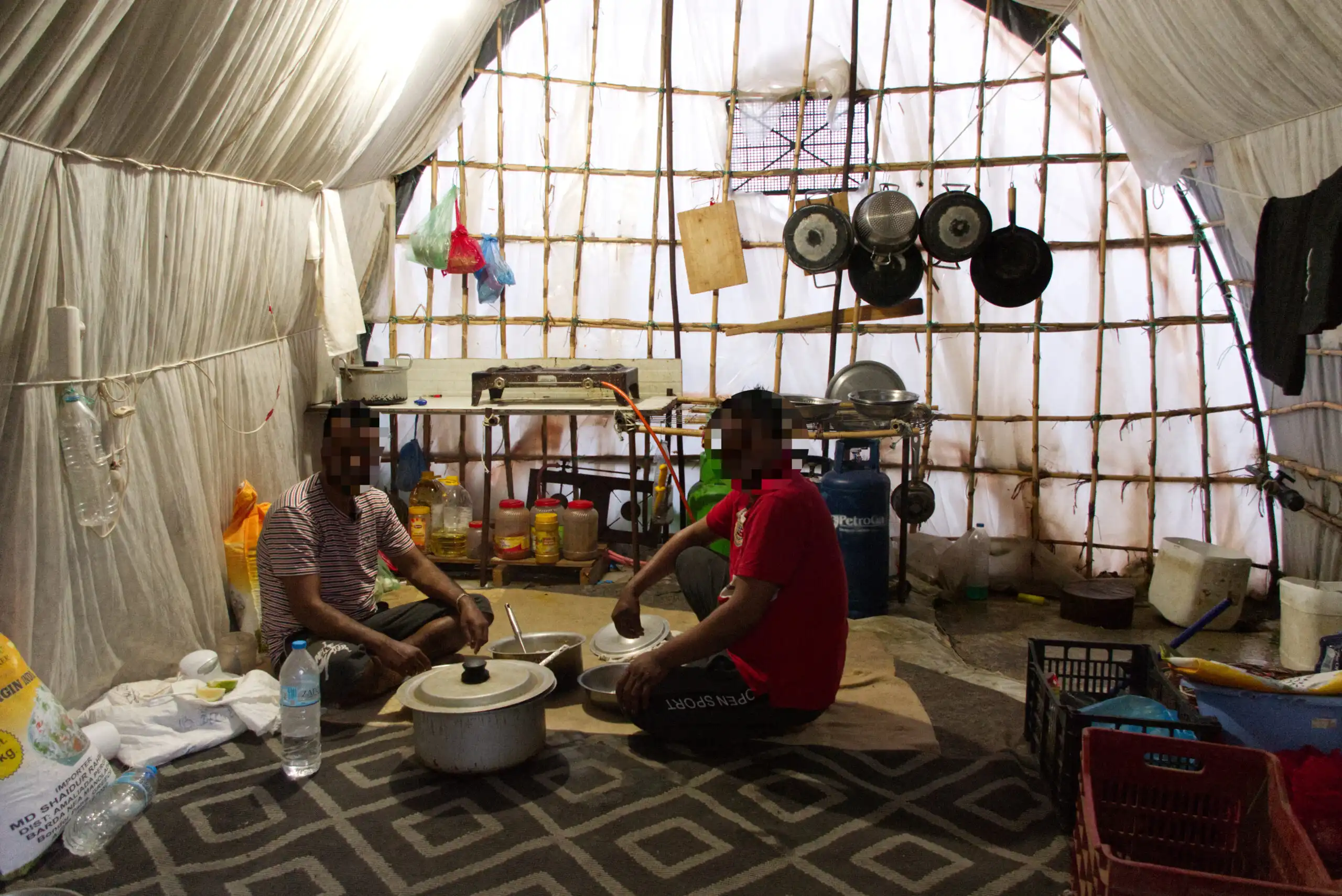
Greek strawberries “made in Bangladesh”
Strawberries are now also available to buy in winter. They thrive in Nea Manolada, Greece, but there are downsides to growing them. Scientist Johannes Jungfleisch has investigated the conditions of South Asian workers.